

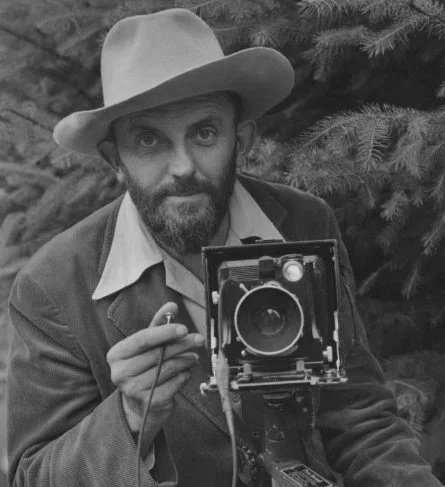
Image Source: CALIFORNIA MUSEUMANSEL EASTON ADAMS
1902 - 1984
The Visionary of the American West
Ansel Easton Adams stands as an enduring icon of American photography and environmental conservation. His name is synonymous with the dramatic, sharp-focus black-and-white vistas of the American West, capturing the monumental majesty of landscapes that came to define the national identity of the wilderness.
As a photographer, lecturer, writer, and teacher, Adams did not merely document nature; he transformed photography into a recognized fine art and leveraged his creative mastery to protect the spaces he loved. Over a career spanning more than six decades, his technical innovations and artistic philosophy reshaped how the world viewed both the photographic medium and the pristine natural world.
ANSEL ADAMS BIOGRAPHY
-
Early Life and the Solace of San Francisco's Dunes
Ansel Easton Adams was born on February 20, 1902, in San Francisco, California. He grew up in the dunes area near the Golden Gate, experiencing a childhood deeply tied to the natural geography of the California coastline. His father, Charles Hitchcock Adams, was a businessman who fostered an environment of patient inquiry, though the family faced financial volatility during Ansel's youth. Ansel was a hyperactive and deeply sensitive child, finding the rigid structures of traditional schooling ill-suited to his disposition. After struggling to fit into several schools, his father decided to provide him with a private education at home, which allowed the young Adams to explore his surroundings freely and develop a profound, independent relationship with nature.
In 1914, at the age of twelve, Adams discovered a passion that would dominate the first half of his life: the piano. He taught himself to read music and soon began formal lessons. The piano provided a crucial outlet for his intense energy and intellect. The discipline required to master the instrument taught him structural precision, nuance, and the concept of interpretation—skills that would later seamlessly translate into his darkroom craftsmanship.
The Turning Point: Yosemite and the Box Brownie
While music occupied his daily studies, a momentous event occurred in the spring of 1916 that irrevocably altered the trajectory of his life. During a family vacation, Adams visited Yosemite National Park for the very first time. Transfixed and transformed by the sheer granite cliffs, cascading waterfalls, and luminous light of the valley, he felt a spiritual awakening. To help him document his explorations, his parents gifted him a Kodak Box Brownie #1 camera.
Eagerly traversing the valley floor and scrambling up steep trails, Adams captured his first amateur photographs. This initial encounter sparked a lifelong devotion to Yosemite, which became his primary creative sanctuary and a recurring subject throughout his artistic career. The following summer, his passion for the high country deepened when he took a job as the custodian of the Sierra Club’s LeConte Memorial Lodge in Yosemite Valley. This position not only allowed him to spend long months embedded in the wilderness but also brought him into direct contact with early leaders of the American conservation movement.
The Dual Passions: Piano versus Photography
Throughout the 1920s, Adams straddled two demanding artistic paths: a burgeoning career as a concert pianist and an increasingly serious pursuit of photography. For years, he considered photography merely a secondary passion, an extension of his love for hiking and mountaineering in the Sierra Nevada. His first published photographs appeared in the Sierra Club’s Bulletin in 1922, and by 1923, he was selling prints through Best’s Studio in Yosemite Valley.
Despite his growing talent with the camera, Adams spent hours every day practicing the piano, believing music to be his true profession. As late as 1945, long after achieving international fame as a photographer, he still retained enough respect for his musical abilities to make recordings of his interpretations of Ludwig van Beethoven, Frédéric Chopin, and other classical masters. The dual tracking of these arts informed his unique approach to the photographic print. He famously noted that the negative is the composer's score, and the print is the performance, emphasizing that a single negative could be performed in many different ways in the darkroom.
1927: The Pivotal Year and the Monolith
The year 1927 proved to be the most critical turning point in Adams's life. It was during this year that he achieved a profound breakthrough in visual visualization. While on an excursion in Yosemite, he sought to photograph the majestic sheer face of Half Dome. With only a few photographic plates left, he realized that a standard exposure would not capture the emotional weight and stark contrast of the scene as he felt it. He utilized a deep red filter to deliberately darken the sky and accentuate the brilliant white of the snow-draped granite cliff.
The resulting image, Monolith, The Face of Half Dome, was a masterpiece of composition and tonal drama. It demonstrated a shift from merely recording a scene to actively visualizing the final print before exposing the negative. This single photograph accelerated his reputation and firmly established his mature artistic style.
The year 1927 also brought crucial personal and professional connections. Through the patronage of San Francisco businessman and arts supporter Albert Bender, Adams found himself introduced to a stimulating circle of writers, poets, and artists, including Mary Austin and Robinson Jeffers. Bender also helped finance Adams's first portfolio, Parmelian Prints of the High Sierras, which brought his work to a wider, appreciative audience. Furthermore, 1927 marked the year Adams met the influential photographer Edward Weston, sparking a deep professional camaraderie and creative alliance that would reshape American modernism.
Choosing the Lens: The Influence of Paul Strand
By the end of the decade, the friction between his two careers reached a crisis point. The turning point arrived in 1930 during a visit to Taos, New Mexico, where Adams met the celebrated American photographer Paul Strand. Strand showed Adams the negatives he was producing in the Southwest. Adams was profoundly struck by the rich, luminous tonality and absolute simplicity of Strand's compositions.
Seeing these negatives convinced Adams of the inherent power of "pure" photography—art that relied on the unique characteristics of the camera rather than mimicking other mediums. Witnessing Strand's work confirmed Adams's evolution away from the soft-focus, romanticized aesthetics of Pictorialism toward a realistic, sharp-focus style. By approximately 1930, Adams made the definitive decision to abandon his career as a concert pianist and commit his life entirely to photography.
The Battle Over Pictorialism and the Birth of Group f/64
When Adams committed to photography full-time, the prevailing trend in artistic photography was Pictorialism. Pictorialists argued that for photography to be considered fine art, it had to resemble traditional art forms like painting or charcoal drawing. They achieved this by using soft-focus lenses, diffusing filters, hand-coloring, and manipulating chemical processes to obscure sharp details and create romanticized textures. Though Adams had experimented with these techniques in the early 1920s—such as using the bromoil process on his 1921 print Lodgepole Pines, Lyell Fork of the Merced River—he quickly grew to loathe the style. He viewed it as a betrayal of the camera's true capabilities.
Adams became embroiled in a fierce, public ideological battle with prominent Pictorialists, most notably William Mortensen. Throughout the 1930s, Adams and Mortensen traded sharp intellectual blows in the pages of the photography magazine Camera Craft, with Adams aggressively championing clarity, realism, and precision against Mortensen's stylized fabrications.
To formalize this artistic rebellion, Adams, Edward Weston, Imogen Cunningham, and several other Bay Area photographers founded Group f/64 in 1932. Named after the smallest aperture setting on a large-format camera lens, which yields the maximum depth of field and sharpness, the group advocated for "pure" or "straight" photography. They insisted that photographs should feature immaculate sharp focus, maximize the entire photographic gray scale from absolute black to brilliant white, and entirely shun any manipulative effects borrowed from painting or drawing. Although Group f/64 was a loose and relatively short-lived association, its manifesto shook the art world and established sharp-focus modernism as the dominant photographic aesthetic of the mid-20th century.
The Scientist of Light: The Zone System and Technical Mastery
As a photographer who demanded absolute perfection from his prints, Adams recognized that standard exposure methodologies were often inadequate for capturing the massive contrast ranges found in natural landscapes. To solve this problem, Adams, alongside fellow photographer and instructor Fred Archer, developed the Zone System.
The Zone System is a precise technical methodology that allows photographers to systematically analyze the light in a scene and map it to specific values on the final print. It divides a photographic image into eleven distinct zones, ranging from Zone 0 (absolute black with no texture) to Zone X (pure, brilliant white with no detail). Middle gray, the standard calibration point for light meters, is designated as Zone V. By metering specific elements of a landscape—such as a dark shadow under a rock or a bright cloud in the sky—and adjusting exposure and darkroom development times accordingly, Adams could precisely control the contrast and detail of his negatives.
This technical breakthrough transformed photography from a guessing game into a predictable science. Adams shared this extensive technical expertise with the world through a landmark series of instructional manuals. His books, including The Camera, The Negative, and The Print, became the definitive bibles for generations of darkroom practitioners and fine-art photographers, securing his legacy as one of the greatest photographic technicians in history.
Institutionalizing Photography as Art
Adams's mission was not merely to perfect his own work, but to elevate the status of photography within the broader institutional art world. In the early 20th century, major museums rarely collected or exhibited photographs as fine art. Adams set out to change this paradigm. He played an instrumental role in co-establishing the very first independent department of photography at the Museum of Modern Art (MoMA) in New York City, working alongside figures like curator Beaumont Newhall. He also helped co-curate MoMA’s inaugural exhibition dedicated solely to the medium, a monumental step toward cementing photography's legitimacy within elite art spaces.
In 1952, Adams expanded his educational and promotional crusade by co-founding the photography quarterly magazine Aperture alongside Beaumont and Nancy Newhall, Dorothea Lange, and Minor White. Aperture was envisioned as a serious, contemplative journal dedicated entirely to the merits of photographic art, providing a platform for serious criticism, visual portfolios, and philosophical discourse. Through these institutional efforts, Adams helped build the structural foundations that support fine-art photography to this day.
The Environmental Crusader: Art in Service of Nature
For Ansel Adams, photography and environmental conservation were inextricably linked. He was deeply influenced by the environmental credo of the Sierra Club, an organization he served faithfully as a member and leader for decades. Adams realized that his crisp, highly detailed landscapes could serve as potent political tools to shock the public and politicians into recognizing the urgent need to protect endangered wilderness areas.
In the late 1930s, Adams compiled a magnificent book of images titled Sierra Nevada: The John Muir Trail. This volume, showcasing pristine alpine lakes, jagged peaks, and untouched forests, caught the attention of President Franklin D. Roosevelt and his Secretary of the Interior, Harold Ickes. Deeply moved by the luminous beauty documented in Adams's pages, Roosevelt utilized the photographs as visual evidence during congressional debates. This direct political deployment of art contributed significantly to the passage of legislation establishing Kings Canyon National Park in 1940. Adams later remarked that he felt his photographs had a genuinely helpful effect on convincing Congress to pass the preservation bill.
Recognizing his unique ability to capture the soul of the American terrain, Secretary Harold Ickes officially commissioned Adams in 1941 to photograph the country's extensive system of National Parks, public lands, and monument areas. This historic commission resulted in some of his most widely recognized imagery, capturing a grand visual record of the American continent before the post-war boom altered many of its natural borders.
Documenting Manzanar and Human Suffering
While Adams is celebrated almost exclusively for his depopulated, pristine nature photographs, his career also included powerful excursions into documentary photography. Following the outbreak of World War II and the subsequent forced relocation of Japanese-American citizens, Adams was deeply disturbed by the civil liberties violations occurring on American soil. He traveled to the Manzanar War Relocation Center, a bleak internment camp located in the desert expanse of California's Owens Valley.
There, Adams departed from his traditional subject matter to photo-document the daily lives, hardships, and resilience of the interned Japanese-American families. He captured poignant portraits of doctors, farmers, and children working to build a community under unjust conditions. This body of work, later published in his book Born Free and Equal, demonstrated a humanitarian dimension to Adams's eye, showing that his commitment to justice and observation extended to the human condition during moments of national crisis.
Later Career, Recognition, and Final Years
In his later decades, Adams moved away from arduous, high-altitude backcountry expeditions, focusing instead on printing his massive archive of negatives, teaching, writing, and continuing his advocacy for environmental preservation. He established a permanent home in Carmel-by-the-Sea, California, overlooking the dramatic Pacific coastline. His technical perfectionism never wavered; he would spend days in his darkroom refining his most famous negatives—such as Moonrise, Hernandez, New Mexico—seeking to pull the ultimate expressive performance from the silver gelatin medium.
By the 1970s and 1980s, Adams had achieved a level of public affection and celebrity status rarely afforded to visual artists during their lifetimes. His images appeared on calendars, posters, and museum walls worldwide, making him a household name. In 1980, President Jimmy Carter awarded Adams the Presidential Medal of Freedom, the nation's highest civilian honor, citing his lifelong efforts to preserve the American wilderness through his incomparable artistic vision.
Ansel Adams died on April 22, 1984, in Monterey, California, at the age of eighty-two. Following his death, his massive archive—consisting of more than 2,500 fine prints, thousands of negatives, extensive correspondence, and photographic equipment—was preserved at the Center for Creative Photography at the University of Arizona in Tucson, ensuring that researchers and artists could study his craftsmanship for generations to come.
An Enduring Legacy
The legacy of Ansel Adams remains an extraordinary phenomenon in American culture. He succeeded in creating a definitive visual vocabulary for the wilderness, portraying nature not as a resource to be exploited, but as a sacred, pristine temple that demands active stewardship. His rigorous formulation of the Zone System fundamentally elevated the technical execution of black-and-white photography, providing an enduring framework for artistic expression. Beyond the technical and institutional milestones, the enduring love that the public continues to pour out for his images underscores his unparalleled success as a communicator. Ansel Adams taught the world how to look at the landscape with deep reverence, proving that a single focused life can alter the aesthetic and ecological history of a nation.
1962
Gelatin silver print
19 1/2 x 26 3/8 inches
Signed: lower right
INQUIRE