

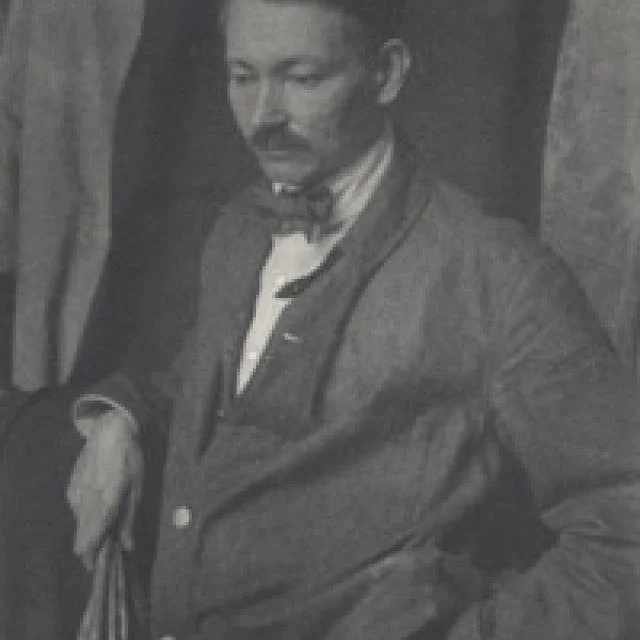
Image Source: NATIONAL GALLER OF ARTROBERT HENRI
1865-1929
Much has been written about the artist Robert Henri. Respected for his theory and criticism, the followers of his technique and instruction made him a legend in his own time.
Some even regard him as the artist who single-handedly led the way to a break with nineteenth century European tradition resulting in a revolutionary American art.
ROBERT HENRI BIOGRAPHY
-
Robert Henri was born Robert Henry Cozad in Cincinnati, Ohio, in 1865. His father, John Jackson Cozad, an entrepreneur, moved the family to Nebraska in 1872 where he created his own town of Cozad. Henri returned to Cincinnati for school but spent his summers from 1872 to 1882 on the open plains of Nebraska. In 1882, John Cozad became embroiled in a murder charge of a cattle herder, for which he was eventually exonerated.(1) Consequently, the Cozad family moved to several cities before settling in Atlantic City.
During a previous move to New York, the family members had changed names, so the artist became "Robert Henri," utilizing the French form of his original middle name. In 1886, Henri entered the Pennsylvania Academy of Fine Arts, where he came under the influence of Thomas Anshutz and Thomas Hovenden. These years also included his initial ventures to Europe; trips that provided him with his first glimpses of the coast of Ireland, a landscape with which he immediately fell in love and would return to utilize in the future.
His travels in Europe included studies with William Adolphe Bouguereau at the Académie Julian before joining the exclusive ranks of students at the École des Beaux-Arts, where he enrolled in the ateliers of the painters, Jean-Léon Gérôme and Léon Bonnat and of the sculptor Augustin-Alexandre Dumont. In France, he became familiar with painters such as Pierre Puvis de Chavannes and Claude Monet, allying himself with the Impressionist movement's break with academic tradition.
Henri returned to the United States only to rebel against the teachings of Robert Vonnoh at the Pennsylvania Academy of Fine Arts. He began his first teaching job at the Philadelphia School of Design for Women along with his informal gatherings of the Charcoal Club whose weekly meetings of artists included Everett Shinn and George Luks. As a teacher and one whose voice of criticism was sought after by other artists, Henri promoted "Paint what is real to you."
Henri's rebellion against academic establishment continued and gained momentum. In an apparent contradiction, he was elected a member of the National Academy of Design in 1906, yet he served as a major player in exhibitions that challenged the Academy's hold on American artists and sales. In 1907, the Academy's rejection of paintings by Luks and his contemporaries led Henri to remove his work from the annual exhibition and to organize his own display at Macbeth's Gallery in 1908.
The exhibition of "The Eight" as they would became better known, was a success and the artists whose work reflected their time and place in America received much due recognition. Henri was then instrumental in organizing the Exhibition of Independent Artists in 1910, which had a direct impact on the success of the infamous Armory Show in 1913.
Henri continued teaching and eventually formed his own school in 1909. Henri was a powerful instructor whose students listened and adhered to his ideas, taking the time to experience their own lives and paint what they saw around them. Henri's portraits reflect his appropriation of the examples of Hals, Velázquez, and Rembrandt into his own personal vision.
For example, he frequently employed a plain background and limited palette of colors. Throughout his career, Henri employed several different color theories. Whether choosing a three-color palette base or pairs of complementary colors, he found color of significant importance within each composition.
Henri removed himself from the chaos of New York every summer, taking trips to find various sources of inspiration and subject matter for his work. His summer restlessness ended when he discovered Santa Fe, New Mexico, and Achill Island, located off the coast of Ireland. On Achill Island, Henri found subjects that fit his search for "my people," those who had not been spoiled by civilization.
Henri stated, "Folk who live in remote places, and especially those who live on islands, are thrown on their own responsibility for amusement, and in the general life, each one has to develop the power to entertain others and himself, and so they become exceptional people. There is a lot of detail of life in great communities which they do not know, but they become possessed, through the force of necessity, of facts of life which it would be desirable for any city man to know."
Just such people whose simple lives centered on fishing and farming inhabited Achill Island. After many trips to Ireland, Henri purchased a home there in 1924 and spent every remaining summer on Achill Island. Henri's respect for the simple, unassuming people is apparent in his written and spoken word, but mostly in his portraits of them.
Henri devoted the last few years of his life to depicting a young children. The artist stated, "Children are greater than the grown man. …I have never respected any man more than I have some children. In the faces of children I have seen a look of wisdom and of kindness expressed with such ease and such certainty that I knew it was the expression of a whole race."(2)
Footnotes:
1. One of many sources for biographical information is William Innes Homer, Robert Henri and His Circle (New York: Hacker Art Books, 1988).
2. Robert Henri, The Art Spirit (New York: Harper & Row, 1923), 22-26.
Submitted by the staff of the Columbus Museum, Georgia.
1914
Oil on canvas
41 ½ x 32 ¾ inches
SOLD