

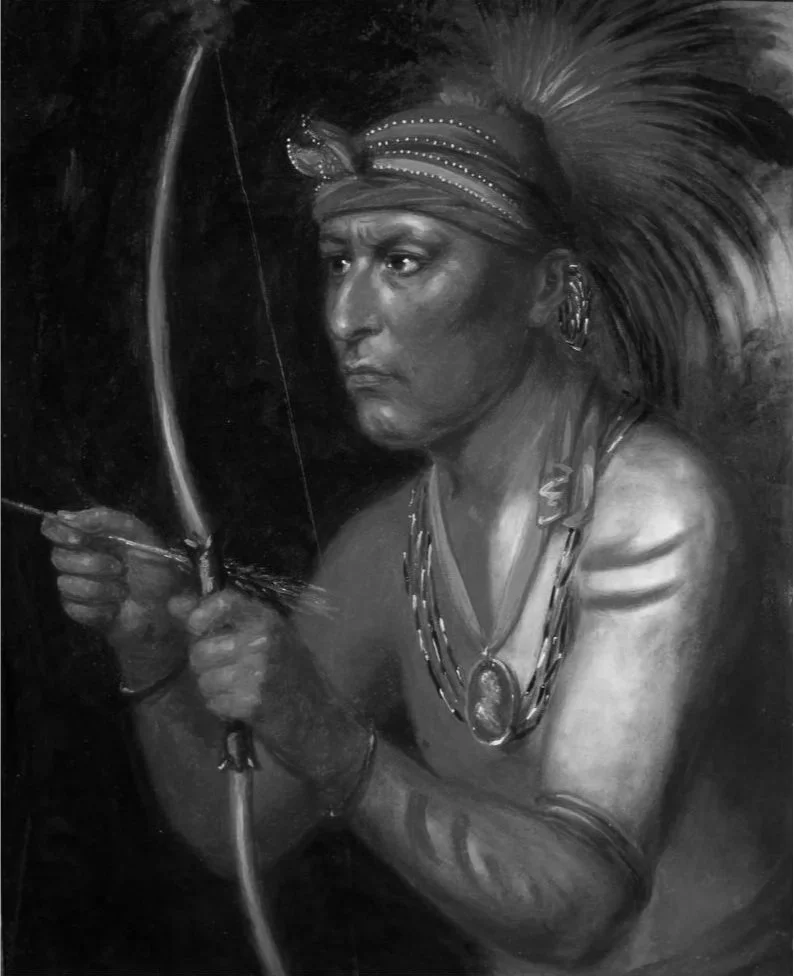
Image Source: ADDISON ROWE GALLERYCHARLES BIRD KING
1785-1862
Charles Bird King was a pivotal figure in early American art, best known as the first artist to systematically document Native American leaders.
Born in Newport, Rhode Island, King’s childhood was marked by tragedy; at age four, his father, Captain Zebulon King, was killed by Native Americans on the Ohio frontier.
Despite this personal history, King later devoted decades to portraying Native dignitaries with significant empathy and technical precision.
-
King’s formal training began in New York under Edward Savage and continued in London at the Royal Academy of Arts, where he studied under the mentorship of Benjamin West. He returned to the U.S. in 1812, eventually settling in Washington, D.C., in 1818. His studio became a social hub for the nation's elite, allowing him to paint prominent figures such as John Quincy Adams, Henry Clay, and John C. Calhoun.
His most enduring legacy is the Indian Gallery, a series of 143 portraits commissioned by the Bureau of Indian Affairs. Between 1822 and 1842, King painted tribal delegates visiting the capital, including notable figures like Sharitarish and Pushmataha. Tragically, the majority of the original portraits were destroyed in a 1865 fire at the Smithsonian Institution. However, his work survives through lithographic reproductions in the landmark three-volume set, History of the Indian Tribes of North America .Beyond portraiture, King was a master of still life and trompe l’oeil, often incorporating Dutch-inspired realism into his compositions. He remained an active member of the Washington art scene until his death in 1862, leaving behind a vital visual record of American history.
(To Dash the Water Off), A Fox Chief; Alternative spelling, Powashiek
Oil on panel
17 ½ x 13 ½ inches
Verso: three exhibition labels
INQUIRE