

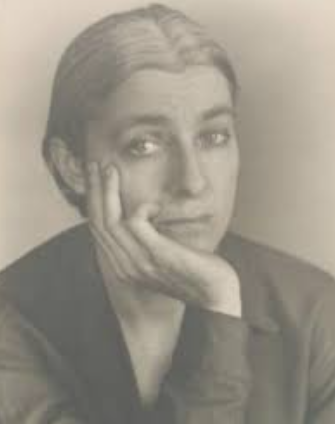
Image Source: emuseum.mfah.org
REBECCA STROUD SALSBURY JAMES
1891-1968
Rebecca Salsbury James (1891–1968) occupied a singular place in the story of twentieth-century American modernism—an artist whose life bridged the theatricality of the American frontier, the intellectual ferment of Manhattan’s avant-garde, and the quiet, enduring majesty of northern New Mexico.
Born in London in 1891 while her father, Nathan Salsbury, was managing Buffalo Bill’s Wild West show, James spent her earliest years in the company of frontier legends before settling in New York. By the 1920s, through her marriage to pioneering photographer Paul Strand, she had stepped into the inner sanctum of the Stieglitz Circle. Known affectionately as "Beck," she was far more than a muse to Strand and Alfred Stieglitz, or a lifelong confidante to Georgia O’Keeffe; she was an active participant in the birth of an American modernist aesthetic. Surrounded by figures such as Marsden Hartley and John Marin, the entirely self-taught James began developing a visual language entirely her own.
REBECCA STROUD SLASBURY JAMES BIOGRAPHY
-
That voice found its true resonance in the summer of 1929, when James traveled to Taos, New Mexico, alongside O’Keeffe at the invitation of Mabel Dodge Luhan. Captivated by the clarity of the high-desert light and the rich cultural traditions of the region, James relocated permanently to Taos in 1933. There, working in quiet independence, she mastered one of art history’s most demanding and luminous techniques: reverse painting on glass. Working backward on the underside of a glass panel—laying down highlights before shadows and backgrounds last—she achieved a jewel-like brilliance and modernist restraint that transformed Southwestern flora, sacred iconography, and intimate still lifes into objects of quiet contemplation.
In the later decades of her career, James turned her disciplined eye toward another regional tradition. Learning the historic Spanish colonial colcha embroidery stitch from her Taos neighbor Jesusita Perrault, she elevated a centuries-old folk craft into the realm of fine modernist abstraction, helping ignite a lasting revival of the medium.
Today, the works of Rebecca Salsbury James hold profound appeal for discerning collectors. For seasoned connoisseurs of American modernism, her oeuvre offers an essential, deeply personal link to both the Stieglitz Circle and the Taos art colony—distinguished by technical rigor and scarcity. For emerging collectors, her work presents an extraordinary entry point into museum-caliber history: the rare opportunity to acquire pieces by an uncompromising, fiercely original artist whose vision continues to captivate generations.
ca. 1930's
Pastel on board
27 1/2 x 21 1/2 inches
INQUIRE