

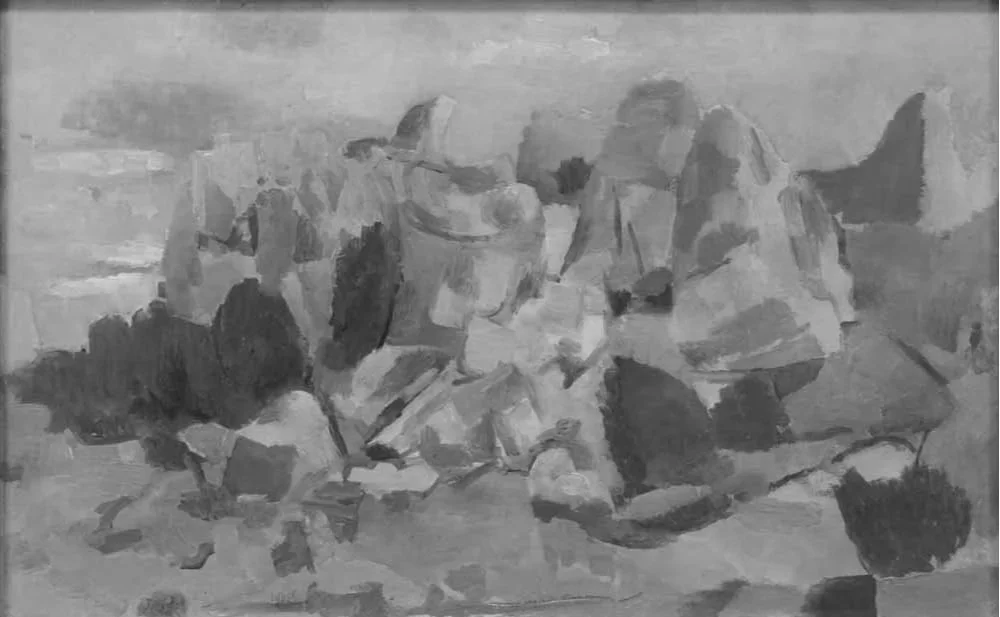
Image Source: ADDISON ROWE GALLERYWILLARD AYER NASH
1898-1943
Willard Ayer Nash was an influential American modernist painter, known for his vibrant landscapes and figure paintings. Born in Philadelphia, he found early success as a commercial artist in Detroit before relocating to Santa Fe, New Mexico, in 1920, a move that would define his artistic career.
There, he became a founding and arguably the most progressive member of the artist group Los Cinco Pintores, known for their bold use of color and local themes.
WILLARD AYER NASH BIOGRAPHY
-
Nash's style was eclectic, moving through phases influenced by the Fauves and Cubism, earning him the moniker "the American Cézanne." He was an "experimenter in art" who explored abstraction while embracing the unique light and landscape of the Southwest. His work included painting and lithography, and he completed six panels for the University of New Mexico's library under the WPA program in 1934. In 1936, he moved to California to teach at the San Francisco Art Institute and the Art Center School in Los Angeles. His art is housed in major museum collections, including the Los Angeles County Museum of Art and the New Mexico Museum of Art.
Willard Ayer Nash's contribution was crucial in bringing modernist sensibilities to the traditional art communities of the American Southwest. His bold, experimental approach, which stood out from his contemporaries, helped to expand the definition of New Mexico art beyond simple regionalism.
Los Cinco Pintores ("The Five Painters") was a short-lived but highly influential group of young American artists who helped usher in the modernist art movement in Santa Fe, New Mexico, in the early 1920s. They challenged the established art community with a focus on vibrant color and a goal to "take art to the people".
The Group: "The Five Nuts in the Adobe Huts"
The five members of Los Cinco Pintores were:
Jozef Bakos (the founder)
Fremont Ellis (the last surviving member)
Walter Mruk
Willard Nash (the most modernist of the group)
Will Shuster (co-creator of the Zozobra tradition)
All were in their twenties and new to Santa Fe when they formed their collective in 1921. They lived and built homes in a compound of adobes along Camino del Monte Sol near Canyon Road and considered themselves the radical young avant-garde artists of Santa Fe.
Oil on canvas
18 × 24 inches
INQUIRE