

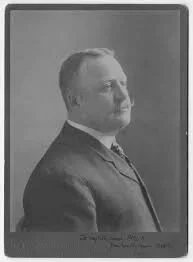
FREDERIC REMINGTON
1873-1956
Image Source: ST. LAWRENCE UNIVERITY LIBRARYFrederic Remington (1861–1909) was a premier artist of the American West whose style evolved from journalistic realism to expressive Impressionism.
Born in New York, he briefly studied at Yale and the Art Students League before his obsession with horses and frontier life drew him westward.
FREDERIC REMINGTON BIOGRAPHY
-
Frederic Remington's artistic style evolved from realistic, detailed illustrations into complex, moody Impressionism and innovative bronze sculpture. His work is primarily characterized by the following phases and techniques:
1. Early Illustration and Realism (1880s–1890s)
Initially famous for his magazine illustrations, Remington developed a "tight," linear style characterized by meticulous detail and historical accuracy.
· Narrative Focus: His early work served as a visual chronicle of the American West, focusing on military life, cowboys, and Native Americans.
· Media: To accommodate 19th-century printing technology, he often worked en grisaille (black and white oil), ink wash, or gouache to ensure clear reproduction in periodicals like Harper's Weekly.
· Horse in Motion: He was one of the first artists to accurately depict the "freeze-frame" mechanics of a galloping horse, moving away from the traditional "hobby horse" pose used by previous artists.
2. Evolution to Impressionism and Nocturnes (1900–1909)
In his final decade, Remington sought to be recognized as a "fine artist" and significantly altered his technique.
· Atmospheric "Nocturnes": He produced over 70 nighttime scenes (nocturnes) that explored the "color of night." These used a muted palette of blues, greens, and blacks to create moody, often ominous, compositions.
· Impressionist Palette: Influenced by American Impressionists, he lightened his palette and used "dappled" fields of color and "bravura" brushwork to emphasize light and shadow over literal detail.
· Tonalism: His late paintings are often associated with Tonalism, focusing on diffused light and soft outlines to evoke specific emotional states.
3. Innovation in Sculpture (1895–1909)
Remington turned to sculpture in 1895, famously stating that he could express motion in three dimensions in ways painting could not.
· The Broncho Buster (1895): His first sculpture became a classic symbol of the West, capturing a cowboy on a bucking horse with an unprecedented sense of balance and intense movement.
· Lost-Wax Casting: He worked closely with the Roman Bronze Works to utilize the lost-wax casting method. This allowed him to achieve intricate textures, such as the "wooly" feel of leather chaps or the tension in a horse's muscles.
· Dynamic Composition: Unlike traditional static statues, Remington’s sculptures often featured figures leaning into extreme angles or supported by a single point of contact with the base to emphasize speed and energy.
4. Legacy and Themes
· The "Vanishing" West: His style shifted from documenting contemporary frontier life to creating romanticized, nostalgic elegies for a way of life that was rapidly disappearing due to industrialization.
· Subjectivity: He eventually prioritized the "artist's subjective experience" over photographic accuracy, believing an artist must "know more than the camera" to convey the spirit of a scene.
1906
Bronze
22 ½ x 16 x 10 inches
Inscribed on base: copyright by Frederic Remington
and ROMAN BRONZE WORKS N.Y.
Stamped under base: No 11
INQUIRE