


Independent 20th Century
September 24 - 27, 2026
Addison Rowe Gallery Presents:
Emil Bisttram - A Chronological Vision
Some artists leave behind remarkable paintings. Others leave behind an entirely new way of seeing the world.
This September, Addison Rowe Gallery is honored to present the work of Emil Bisttram (1895–1976) at Independent 20th Century, Booth 504, at Sotheby's at The Breuer in New York City.
A pioneering American Modernist, educator, and co-founder of the Transcendental Painting Group, Bisttram explored the relationship between abstraction, spirituality, geometry, and the unseen forces that connect us. His paintings invite us to look beyond appearances and consider a deeper harmony within nature, science, and the human experience.
Our presentation traces Bisttram's remarkable artistic journey—from his early commercial illustration and portraiture to important paintings from his Transcendental Painting Group years, his Atom Series inspired by Los Alamos, and intimate works from the 1930s and 1940s.
-
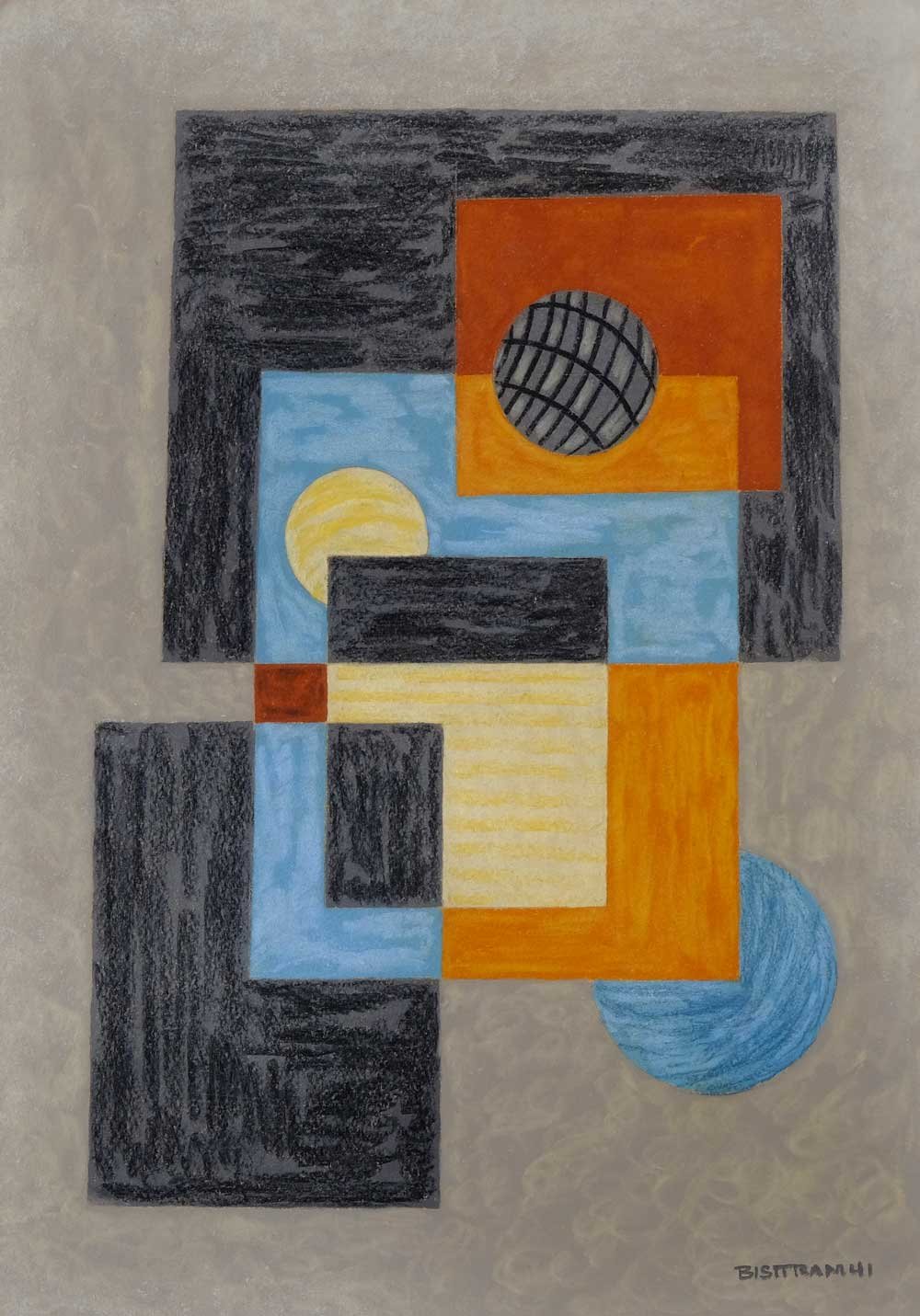
Founded in New Mexico in 1938, the Transcendental Painting Group advocated a radical approach to art: the rejection of landscape and representation in favor of non-objective painting rooted in spiritual principles. The artists believed that form and color, freed from depiction, could directly express inner states, cosmic forces, and spiritual realities. Emil Bisttram stands out within the group for the remarkable breadth of intellectual, spiritual, and scientific traditions he brought to his work.
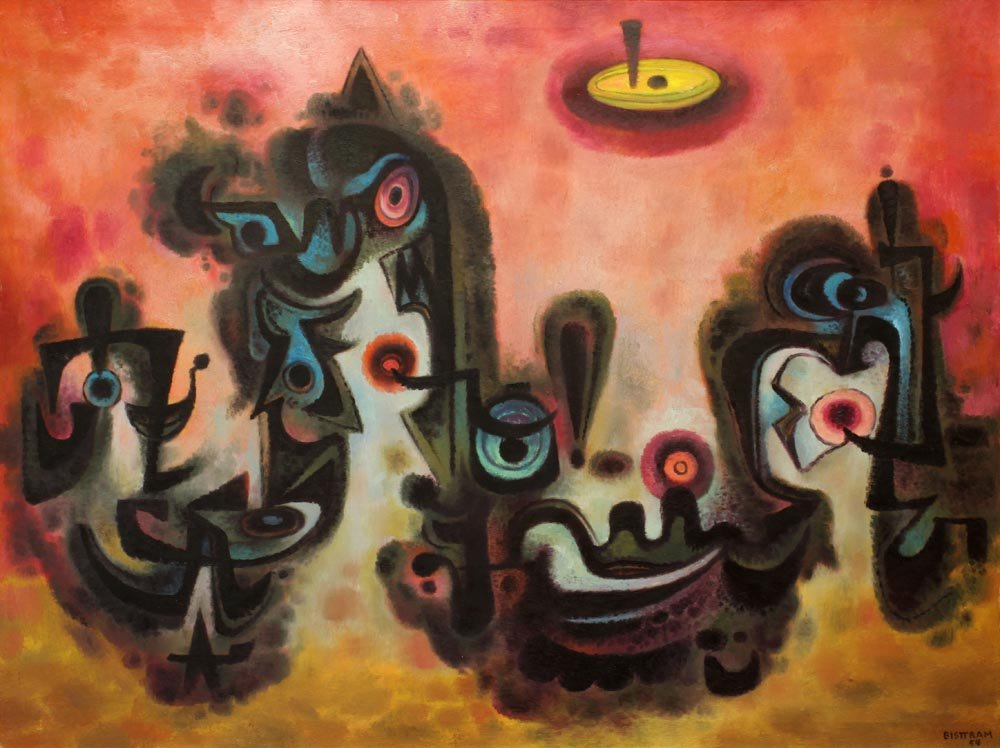
Profoundly spiritual and convinced that all intellectual disciplines lead toward divine truth, Bisttram infused his paintings with references to electricity, rebirth, plant growth, healing through movement and dance, planetary forces, the fourth dimension, and the male and female principles of nature. His compositions are charged with movement and emotion, often structured through complex color harmonies and floating, rhythmic forms. His engagement with scientific ideas is underscored by the inclusion of several of his works in Art and the Atom, the 1951 exhibition curated by the Los Alamos Scientific Laboratory.
Bisttram’s artistic vision was shaped by a highly varied and determined path. After graduating from trade school, he initially worked in carpentry while seeking entry into the art world. He struggled to find stable employment in commercial art before receiving guidance from Dr. Karl Reiland, who encouraged further study and helped him secure a position at the American Lithography Company. His first real opportunity came at Rosenbaum Studios, where he began with errands and paste-ups but gained essential experience in design and production.
In the 1910s, Bisttram pursued formal training at institutions including the National Academy of Design and Cooper Union, studying with figures such as Ivan Olinsky and muralist DeLeftwich Dodge. He became deeply engaged with dynamic symmetry and compositional systems through his studies with Jay Hambridge and Howard Giles, ideas that would become central to his mature work. At the same time, he established a successful commercial art practice, eventually founding the firm Bisttram, Caldwell, and Hill, which served major advertising agencies.
Bisttram’s personal and intellectual life was equally formative. His wife, Mary Huth, was a crucial partner in his career, supporting and managing many aspects of his professional life. His exposure to mysticism—particularly through his association with Nicolas Roerich and the Master Institute of United Arts—had a lasting impact on his philosophy of art. During the 1920s, Bisttram developed a rigorous teaching curriculum centered on dynamic symmetry and color theory, articulating a belief in art as a spiritual and pedagogical discipline.
After the 1929 stock market crash severely curtailed his commercial income, Bisttram sought new direction. He applied for a Guggenheim Fellowship and ultimately traveled to Mexico to study mural painting with Diego Rivera. Soon afterward, he relocated permanently to Taos, New Mexico, marking the beginning of his most innovative and spiritually driven period and solidifying his role as a founding member of the Transcendental Painting Group.
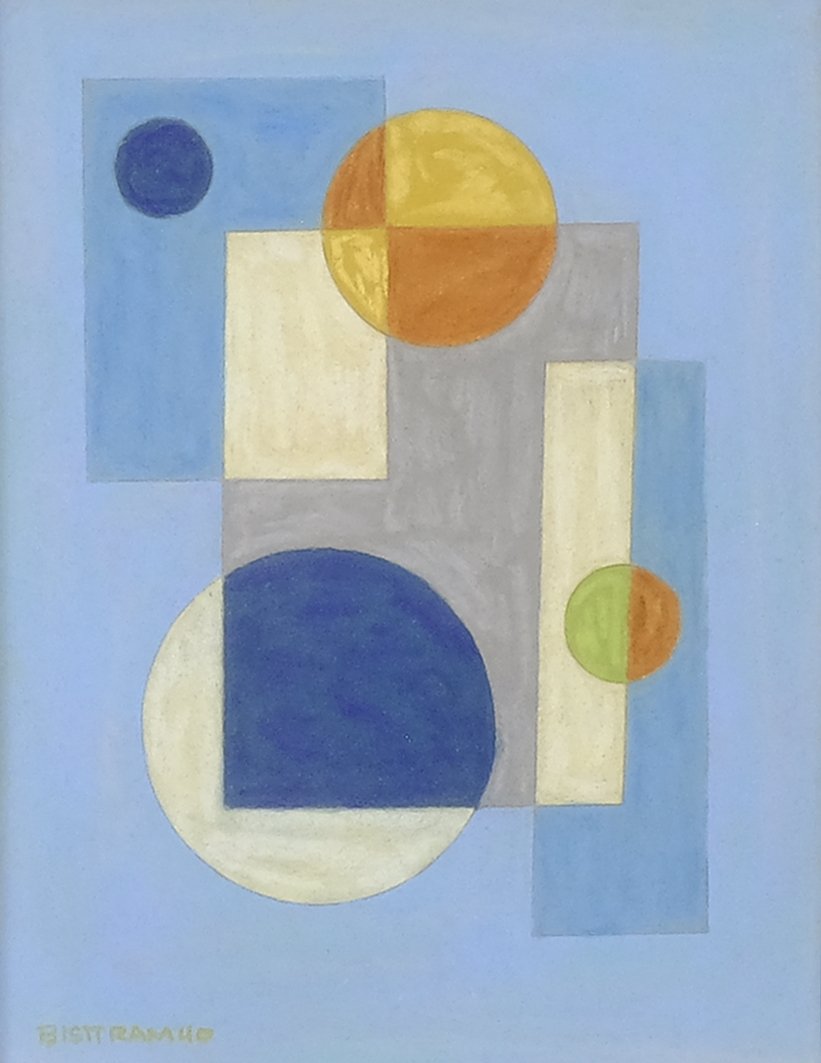
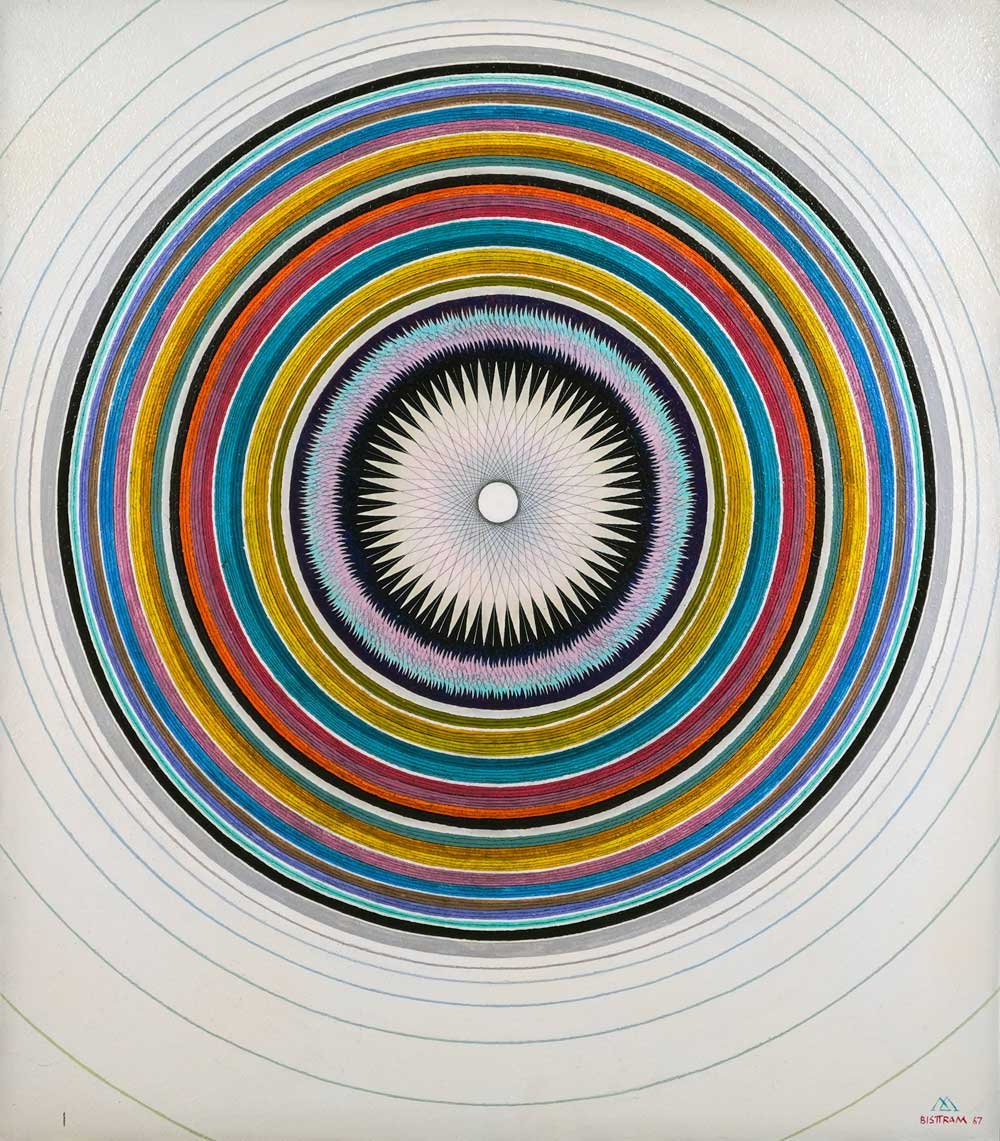
Many of Bisttram’s mature works reflect a fascination with both the macrocosm and microcosm—the vastness of the universe and the hidden structure of the atom. As Henry Hunt, Professor at the University of New Mexico, observed: “The power of his work emanates from his understanding that within the atom lies the infinite structures of basic reality. Bisttram goes behind the surface image of things and reveals the conceptual image of the Universe.” Circles, orbs, and geometric forms in his paintings simultaneously evoke celestial bodies and microscopic structures, reinforcing this dual vision.
This presentation is a rare and compelling cross-section of Bisttram’s career, including:
Illustration and design works from his New York period
Traditional portrait paintings reflecting his study with Diego Rivera
Important, previously unexhibited oil paintings from his Transcendental Painting Group years
Works from his Atom Series created for Los Alamos
Exceptional small-scale paintings from the 1930s and 1940s
Together, these works will offer viewers a comprehensive and visually striking narrative of Emil Bisttram’s evolution—from commercial artist to visionary abstractionist—and reaffirm his significance within American modernism and the history of spiritual abstraction.
EXHIBITION ARTWORKS




1954
Oil on canvas
36 × 32 inches
Signed and dated lower right
INQUIRE